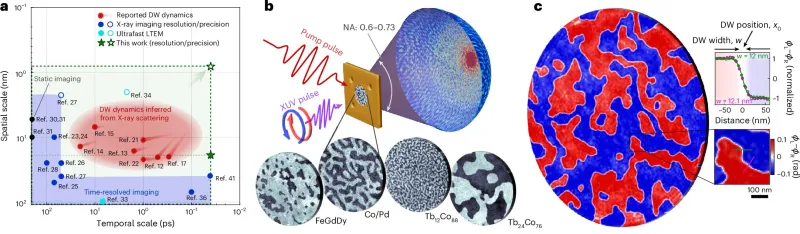
In a breakthrough that could revolutionize the future of data storage, researchers have achieved an unprecedented understanding of nanomagnetism at ultrafast speeds. A team led by physicist Johan Mentink at Radboud University has successfully mapped the behavior of boundaries within magnetic nanostructures on extremely short timescales. This groundbreaking work challenges previous assumptions, revealing that these boundaries exhibit a remarkable degree of stability, far exceeding prior expectations.
The implications of this discovery are profound, particularly for the development of next-generation data storage solutions. The ability to manipulate and control magnetic materials at such high speeds and with such stability opens up new avenues for creating devices that are not only faster but also significantly more compact. Current data storage technologies, while advanced, are approaching their physical limits. The constant demand for higher storage capacities and quicker access times necessitates innovation at the fundamental level of material science.
Mentink's research focused on the dynamics of these magnetic boundaries, which are crucial for the operation of magnetic storage devices. By observing their behavior on femtosecond timescales – an almost unimaginably short duration – the scientists gained critical insights into how these structures respond to rapid changes. This detailed understanding allows for more precise engineering of nanomagnetic components, paving the way for data storage systems that can write and read information at speeds currently unattainable.
Faster data storage is not merely a convenience; it is a critical enabler for numerous technological advancements. From artificial intelligence and machine learning, which require vast datasets to be processed rapidly, to high-performance computing and immersive virtual reality experiences, the demand for speed and efficiency in data handling is ever-increasing. The stability observed in these ultrafast nanomagnetic boundaries suggests that future storage devices could overcome current bottlenecks, leading to more responsive and powerful computing systems.
Furthermore, the prospect of more compact data storage solutions holds significant promise for mobile devices, wearable technology, and the Internet of Things (IoT). As these devices become more integrated into our daily lives, the need for efficient and space-saving storage becomes paramount. The insights gained from this research could lead to smaller, more power-efficient storage chips, reducing the physical footprint of electronic devices and enhancing their overall performance. The scientific community is eagerly anticipating the practical applications of this fundamental discovery, which promises to usher in a new era of data storage technology.
Extreme stability in ultrafast nanomagnetism aids the development of faster data storage
Admin
1 Views
2 min read
Source:
Phys.org