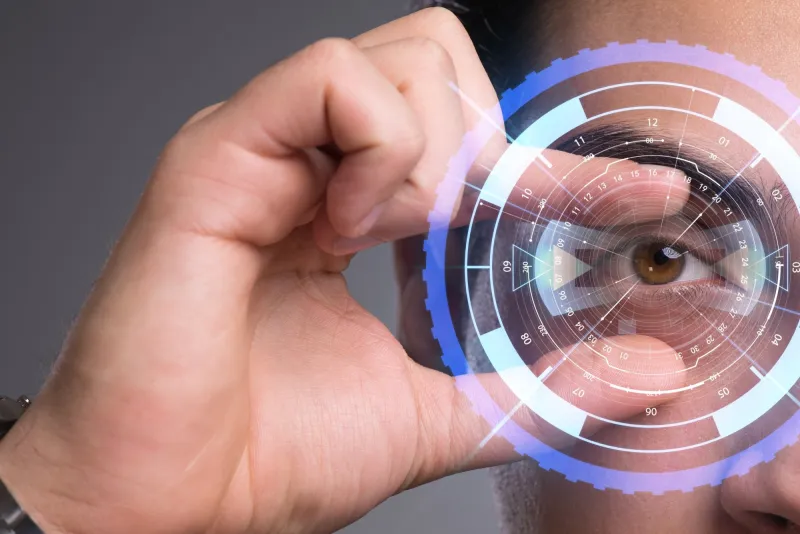
A groundbreaking development in the field of vision restoration is emerging from research into implantable optical devices. Scientists have developed a novel implantable retina that promises to restore sight by enabling individuals to perceive near-infrared (NIR) light. This innovative technology utilizes multilayer optical filters to convert NIR light into signals that the brain can interpret as vision. The research is focused on enhancing visual prosthetics, offering a new avenue for those with significant vision impairment.
Traditional visual prosthetics often aim to mimic natural vision by stimulating the retina or visual cortex with electrical signals. However, this new approach takes a different direction by allowing the user to see a spectrum of light that is normally invisible to the human eye. Near-infrared light, which falls just beyond the red end of the visible spectrum, has various applications and properties that could be beneficial if perceived. The ability to see in the NIR spectrum could offer advantages in low-light conditions or for specialized tasks.
The core of this technology lies in the multilayer optical filters incorporated into the implantable retina. These filters are engineered to selectively capture near-infrared light and then transform it into a format that can be processed by the visual system. The conversion process essentially translates the NIR wavelengths into electrical signals that are compatible with neural pathways. These signals are then transmitted to the brain, where they are interpreted, allowing the user to 'see' the NIR light.
This advancement holds significant potential for individuals suffering from conditions that cause blindness or severe vision loss. By integrating this implantable retina, visual prosthetics could be significantly enhanced. It opens up possibilities for restoring not just basic visual function but also for providing a new sensory modality. The implications for improving the quality of life for visually impaired individuals are substantial, potentially allowing them to navigate their environment more effectively and interact with the world in new ways.
The research is still in its developmental stages, but the successful demonstration of converting NIR light into interpretable signals marks a critical milestone. Future work will likely focus on refining the optical filters, improving the biocompatibility of the implant, and optimizing the signal processing for clearer and more detailed perception. The ultimate goal is to create a safe, effective, and widely accessible solution for vision restoration, pushing the boundaries of what is possible in medical technology and offering hope to millions.
Implantable Optical Device Enables Near-Infrared Vision Restoration
Admin
1 Views
2 min read
Source:
AZoOptics