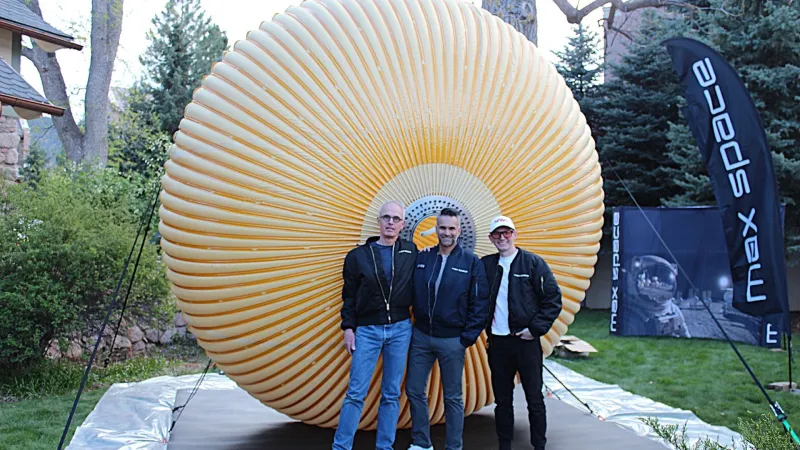
Max Space, a company at the forefront of innovative space architecture, has recently unveiled a significant development in its pursuit of advanced extraterrestrial living solutions: a large sub-scale model of its revolutionary expandable space habitat. This unveiling offers a tangible glimpse into the future of space exploration and habitation, showcasing a design that prioritizes scalability and efficiency for missions to the Moon, Mars, and beyond.
The core innovation behind Max Space's habitat lies in its expandable nature. Unlike traditional rigid structures, these habitats are designed to be compact during launch and then unfurl to create significantly larger interior volumes once in space. This approach drastically reduces launch costs and complexities, as a smaller initial footprint can accommodate a much larger living or working area. The sub-scale model presented demonstrates the sophisticated engineering and materials science that underpin this concept, highlighting the potential for creating substantial habitable spaces with a minimal mass penalty.
"We need real estate that is scalable," stated a representative from Max Space, emphasizing the critical requirement for adaptable and growing infrastructure in space. As humanity's presence in space expands, from lunar bases to potential Martian colonies, the ability to efficiently increase living and working areas will be paramount. Max Space's expandable habitat directly addresses this need, offering a flexible solution that can be augmented or expanded as mission requirements evolve.
The implications of this technology are profound. For lunar missions, such habitats could provide robust shelters for astronauts, offering protection from radiation and the harsh lunar environment, while also serving as laboratories, workshops, or living quarters. For longer-duration missions to Mars, expandable habitats are even more crucial, enabling the creation of self-sustaining outposts that can support crews for extended periods. The ability to quickly deploy and expand living space is a key factor in mitigating the psychological and logistical challenges of deep-space exploration.
The sub-scale demonstration is a crucial step in the development process, allowing engineers and designers to test and refine the deployment mechanisms, structural integrity, and overall functionality of the habitat. It provides valuable data for scaling up the design to full-size modules capable of supporting human crews. Max Space's commitment to developing such advanced technologies underscores the growing momentum in the private space sector towards enabling long-term human presence beyond Earth. The vision of a future where humans can live and work comfortably and sustainably on other celestial bodies is brought closer to reality by innovations like these.
Max Space Unveils New Expandable Space Habitat for the Moon and Beyond: 'We Need Real Estate That Is Scalable'
Admin
1 Views
3 min read
Source:
Space