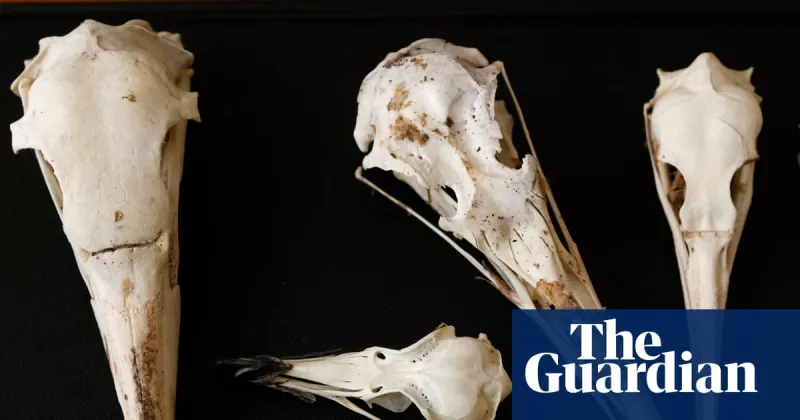
A fascinating new line of scientific inquiry suggests that the humble skull of a bird might hold the key to understanding the complex inner lives and behaviors of their ancient, colossal ancestors: the dinosaurs. Dr. Stephen Brusatte, a paleontologist at the University of Edinburgh, has proposed that by meticulously studying the cranial structures of modern birds, scientists can gain unprecedented insights into the brains and sensory capabilities of extinct dinosaurs, painting a vivid picture of how these magnificent creatures perceived and interacted with their world.
The prevailing scientific understanding is that birds are the direct descendants of theropod dinosaurs, a group that famously includes the Tyrannosaurus Rex. This evolutionary link is not merely a matter of shared ancestry but extends to physical characteristics, with many scientists observing striking similarities between avian and dinosaurian anatomy. Dr. Brusatte's hypothesis centers on the skull, which houses the brain and sensory organs. He posits that the size, shape, and internal structure of a bird's skull can serve as a proxy for the brain size and organization of its dinosaurian relatives. By comparing the cranial cavities of various bird species with those of fossilized dinosaur skulls, researchers can infer details about brain volume, the relative proportions of different brain regions (such as the visual cortex or olfactory bulb), and potentially even the complexity of neural pathways.
This comparative approach has profound implications for our understanding of dinosaur behavior. For instance, a larger visual cortex in a dinosaur skull might suggest superior eyesight, indicating that the dinosaur relied heavily on vision for hunting, navigation, or social interactions. Similarly, a well-developed olfactory bulb could point to a keen sense of smell, crucial for tracking prey or detecting predators. The overall size of the brain relative to body mass, known as the encephalization quotient (EQ), is also a critical factor. Higher EQs are often associated with greater intelligence, problem-solving abilities, and more complex social behaviors. By analyzing these cranial clues, scientists can begin to reconstruct the cognitive landscapes of dinosaurs, moving beyond mere skeletal reconstructions to a more nuanced appreciation of their sentience and capabilities.
Dr. Brusatte's assertion that early birds were like 'T-Rex reincarnated' highlights the aggressive and predatory nature that may have been shared by these ancient lineages. The study of avian skulls can reveal adaptations for powerful bites, keen senses, and efficient locomotion, traits that were undoubtedly crucial for survival in the competitive Mesozoic era. Furthermore, understanding the sensory world of dinosaurs—what they saw, heard, smelled, and perhaps even felt—allows us to visualize their ecosystems more vividly and comprehend their ecological roles with greater accuracy. This research opens up exciting avenues for future paleontological studies, potentially revolutionizing how we interpret dinosaur fossils and bringing us closer to understanding the dynamic lives of these long-lost giants.
Scientists believe birds’ skulls hold clues to inner lives of long-extinct dinosaurs
Admin
1 Views
3 min read
Source:
The Guardian